
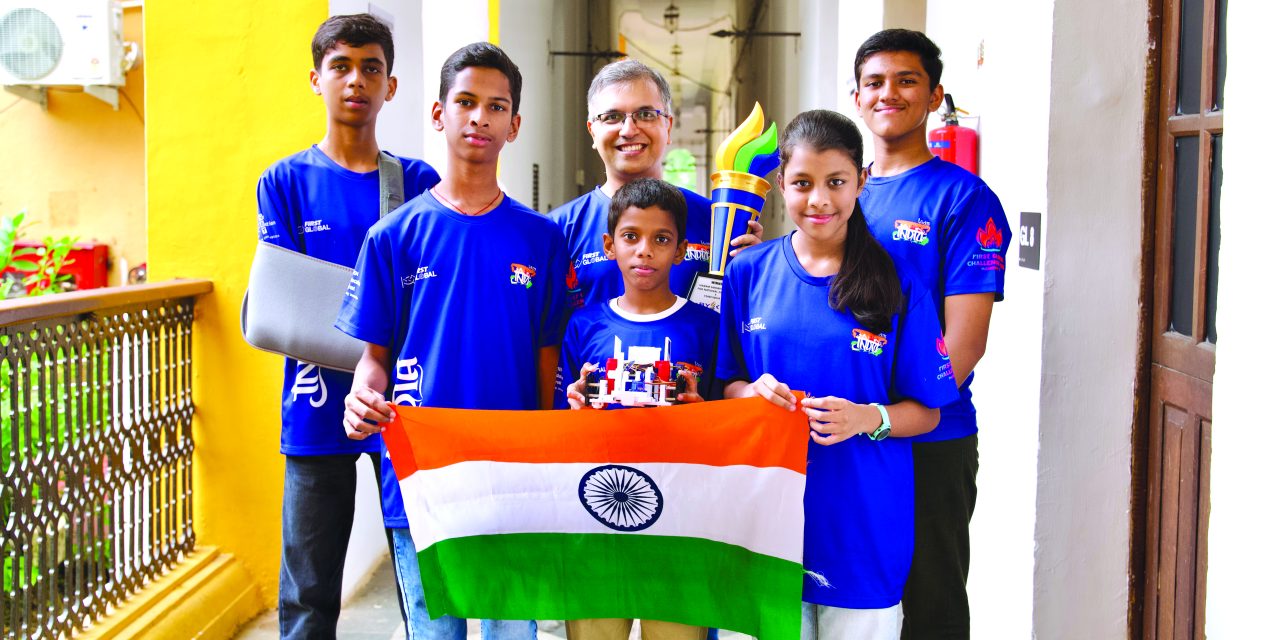
Months of innovation, coding, and teamwork have earned five Goan students a place among the world’s top young robotics talent
Five school students from Goa have been selected to represent India at the FIRST Global Challenge 2026, an international robotics competition to be held in Incheon, South Korea, from October 7 to 10. Each participating country fields a single team to design, build, and program a robot.
The team, Tech Infinity, secured its place after winning the Vikram Sarabhai Award for National Excellence at the Bharatiya Yantra Khel Mahotsav (BYKM) 2026, the national selection event conducted by STEM Education Trust (SET). It will now compete alongside teams from nearly 190 countries. Besides the competition, the students will also take part in cultural exchange programmes with teams from other participating countries.
The team comprises Sparsh Swapnesh Verlekar, Dhruv Samir Salgaonkar, and Soham Mahesh Redkar of Saraswat Vidyalaya, Mapusa; Avaneesh Devendra Phadte of Mushtifund High School, Cujira; and Anam Raza of Podar International School, Old Goa.
Mentor Anay Kamat says the students, who have been training in robotics since 2024, were selected through a multi-stage process that included applications, interviews, and technical assessments.
This year’s FIRST Global Challenge theme, ‘Igniting Innovation’, focuses on reducing the risk and impact of wildfires through technology.
“The idea is not just to compete but to work together,” says Kamat, adding that teams from different countries form alliances during matches and collaborate to complete parts of the challenge.
He says teams are assessed not only on the performance of their robots but also on how effectively they explain the problem their design addresses.
Saieesh Gandhi, a mentor, says the competition also recognises teams for promoting robotics in their communities. Thus, the team plans to conduct workshops and demonstrations in schools to explain how the robot was designed and introduce students to robotics.
But there are challenges on the road to Korea. Founder of SET Gagan Goyal says the team requires about Rs 22 lakh to participate in the competition. He says, “The students have earned the opportunity to represent India, but arranging funds remains our biggest challenge.”
The estimated cost includes travel, accommodation, transporting the competition robot and equipment, and designing and building a new robot for the event. Unlike the robot used at the national selection, the new machine will weigh about 10 to 15 kg and will be built largely from metal.
He says Goa’s limited robotics infrastructure means several components and fabrication services have to be sourced from outside the state. “The students are also balancing preparations for the competition with their academic commitments.”
Goyal adds SET has organised robotics competitions through a volunteer network for the past nine years. “The competitions give students practical experience in science, mathematics and engineering while developing problem-solving, communication and teamwork skills.”
The team hopes to secure support from government agencies, industry and corporate sponsors as it prepares for the competition.









Recent Comments