
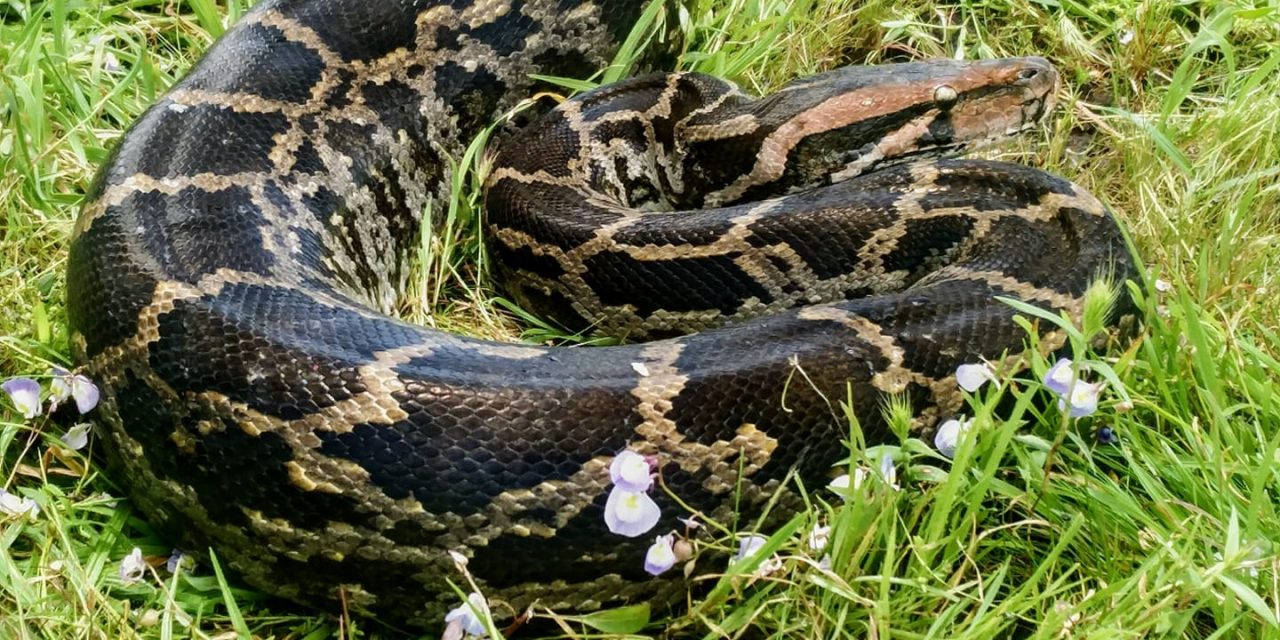
In his new children’s book, Nirmal Kulkarni draws on the story of Chaya, an Indian rock python and his daughter Naia’s observations of the snake in Nerul
RAMANDEEP KAUR | NT KURIOCITY
A python crossing a road or turning up in a Nerul backyard is not an unusual sight. The Indian rock python is part of the village landscape, though its presence can still cause alarm and lead to calls to snake rescuers.
Herpetologist and conservationist Nirmal Kulkarni has turned one such real-life experience into ‘Naia’s Notes on a Gentle Giant’, a children’s book about an Indian rock python named Chaya. Illustrated by Manvi Gupta and published by Niyogi Books under its Perky Parrot imprint, the book was released on Nag Panchami.
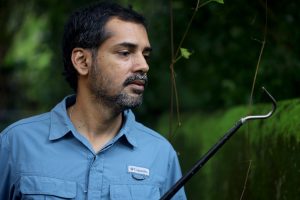
The story is about Naia, a young girl who records her encounters with Chaya in and around her village. It is inspired by Kulkarni’s own life; Nerul was his home for around 15 years and his daughter Naia spent her first five years there. “Naia accompanies me on some of my snake surveys,” he says. “She kept her own scribbles and notes on Chaya, a snake that we frequently saw in Nerul’s mangroves, backyards and on roads.”
Chaya, too, has a real-life connection. Kulkarni says she is partly inspired by an Indian rock python he observed and rescued before releasing it in the same area with support from the local community. He says the snake continues to live in Nerul.
Kulkarni has spent three decades documenting reptiles and other wildlife as a conservation scientist and wildlife photographer. His work in the Western Ghats has included the discovery of five amphibian species. Since 2017, he has also run Living with Pythons, a conservation education initiative focused on coexistence with snakes.
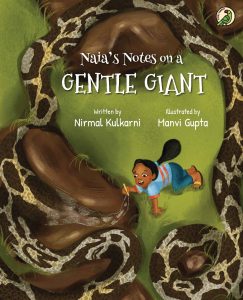
He says, “It was a unique collaboration between Naia and me. We shared thoughts and funny moments from python rescues and observations, along with people and incidents from the village that we know.”
Kulkarni wrote the book to address some of the misconceptions he has come across during his work with snakes. One of the most common is that pythons eat children. “This is wrong,” he says. “They eat small mammals, at times cats and dogs but never has a human adult or child been eaten as it is not their prey.”
Another misconception is that pythons can pull a person towards them by sucking in air. In fact, they catch their prey by surprise and kill it by constriction.
The problem is not limited to misconceptions. As natural habitats shrink, pythons are increasingly found close to human settlements. They also face threats from road traffic and being killed out of fear.
Kulkarni says intolerance can prompt unnecessary intervention. “Pythons, being large and easy to spot, are particularly likely to be moved when they are found near homes. People often seek to relocate every snake they see, which can affect local ecosystems,” he says.
The Indian rock python helps keep rodent and other small mammal populations in check. When one is found near a home, Kulkarni advises people to take a few photographs and leave it alone. “It is a part and parcel of every neighbourhood ecosystem.”
Over the years, Kulkarni says, public awareness has grown, along with the number of people involved in snake rescue. But he feels this has also made people more likely to remove snakes from places where they could be left alone.
“Coexistence is the key,” he says. “Also that pythons are really cool reptiles to observe and be amazed at.”
Kulkarni also reviewed Gupta’s illustrations for the book to ensure that the scientific information was represented clearly. “I love her work,” he says. “It’s spontaneous and very engaging.”
‘Naia’s Notes on a Gentle Giant’ is Kulkarni’s second book. His first, ‘Eye to I’, recounts how he first saw a tiger as a teenager.
The new book is already being introduced in schools and nature education programmes. It is available at Dogears bookstore in Margao and Literati Bookshop and Cafe, Calangute, as well as online through Amazon and Niyogi Books. It is priced at Rs. 350.
Kulkarni is now developing ideas for books about lesser-known species.







Recent Comments