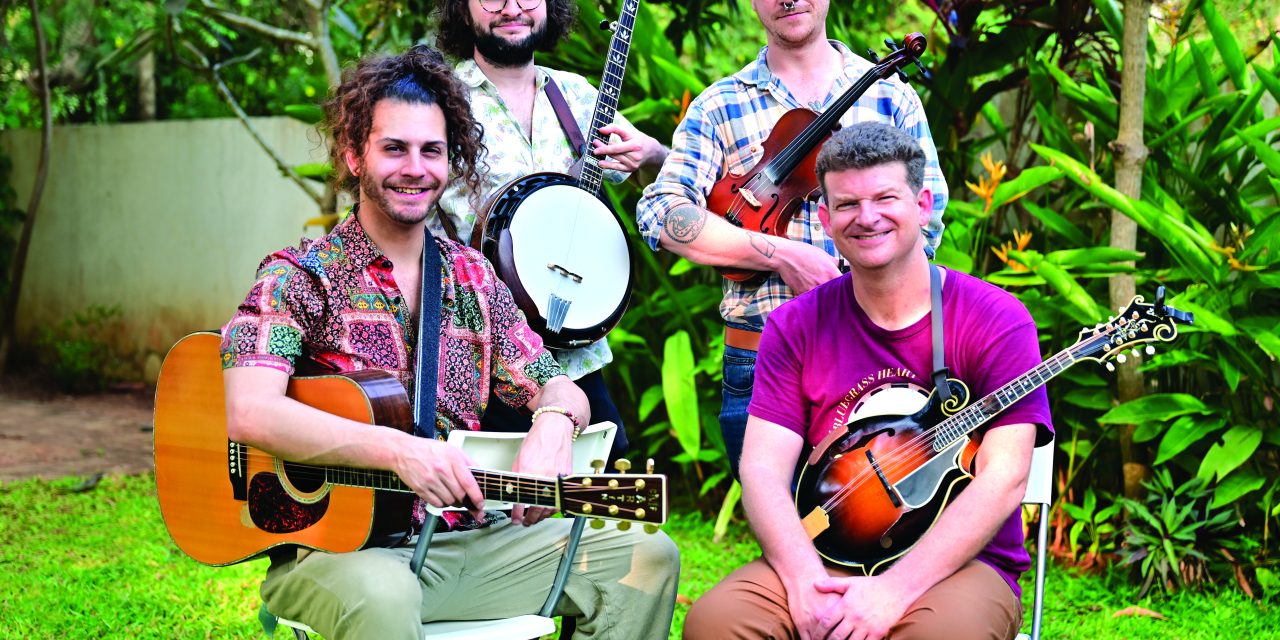
This February, the Bluegrass Journeymen Academy offers Goan students free access to Appalachian bluegrass through hands-on workshops, school visits and performances
VINIKA VISWAMBHARAN
On most afternoons at the Goa Jazz Academy in Guirim, the familiar sounds of piano scales, jazz riffs and young voices rehearsing drift through the corridors. This February, however, something a little different has joined the mix. A bright banjo twang. A quick mandolin melody. The warm scrape of a fiddle keeping time. For many students, it is the first time they are hearing bluegrass music live.
The sound comes from the Bluegrass Journeymen Academy, a collective of musicians and educators from the United States who are in Goa for a month-long residency, conducting free workshops and outreach sessions for students across the state. What began as a touring band several years ago has now grown into an education-focused project that travels with instruments, lessons, and a simple aim: to help young people discover different music by playing it together.
“Bluegrass is very community-based,” says mandolinist Patrick Kerrigan Fitzsimons, one of the founders of the academy. “You don’t need fancy equipment. You just carry your instrument, sit in a circle and start playing. It brings people together really quickly. That’s what we love about it.”
The genre, he explains, traces its roots to the Appalachian mountains of the United States and blends folk, blues and old-time string band traditions. It is built around acoustic instruments such as guitar, banjo, mandolin, fiddle and bass, with a strong emphasis on rhythm, listening, and improvisation. “It is music you make with each other, not at each other,” says Fitzsimons. “Everyone gets a chance to speak through their instrument.”
The group first came together in 2017 as performers, touring cities in India and Nepal. But after years of one-off concerts, they began to feel something was missing. “We would play a show and leave the next day,” recalls Fitzsimons. “It felt temporary. So we thought, why not stay longer and teach? Why not give people the opportunity to actually play bluegrass themselves instead of just hearing it?”
This led to the formation of the Bluegrass Journeymen Academy as a non-profit focused on music education. Goa is their latest stop. For guitarist Chad Andrew Harris who has been playing for two decades and teaching for nearly 15 years, his classroom approach is less about reading notes and more about training the ear. “I’ve seen so many students who can read music perfectly but don’t know how to jam with other people,” he says. “If you can hear something and play it back, you can make music anywhere. That’s what I want them to learn. Listening first!” During sessions, he encourages students to pick up simple chords, play along with others and slowly build confidence. “Music should feel natural,” he adds. “Not like an exam.”
Banjo player Taylor Shuck, who is from Nashville, brings an equally relaxed energy to his classes. To many students here, the banjo is an unfamiliar instrument, but Shuck believes that is part of the excitement. “Once you learn the basic picking patterns, it’s actually fun,” he says. “The banjo gives bluegrass its drive and speed. It’s got a lot of personality.”
He keeps his lessons simple, starting with easy songs and encouraging students to focus on playing together rather than playing perfectly. “You listen to the people around you and respond. That’s how the music grows,” he says.
Violinist Ben Errington, from Scotland, shares a similar philosophy. Having played since the age of three, he believes enjoyment is the key to learning. “The best way to learn is just by playing,” he says. “Not too much theory. We’ll play games, try melodies, and have fun. If they’re smiling, then they’re learning.”
At the Goa Jazz Academy, these visiting musicians will conduct free classes three times a week for participants who already have some basic knowledge of music. Individual instrument sessions are followed by group ensembles, where everyone gathers in a circle and plays together.
The residency also stretches beyond the academy. Each week, the team will visit schools such as The Owl House in Moira, Paradise School in Verla, Gaet International in Bambolim and Rui Lobo’s Music School in Panaji, introducing children to the instruments through hands-on workshops.
For Divya Gupta, co-founder of the Goa Jazz Academy, the collaboration was a natural fit. “They were looking for a partner already involved in education and outreach, and that’s exactly what we do,” she says. “We regularly conduct free sessions and community programmes, so this aligned perfectly with us.” For Gupta, the benefits go beyond learning a new genre. “Exposure is important,” she says. “When students experience different kinds of music and cultures, it opens their minds. It builds confidence and creativity.”
The bluegrass residency will end with a final showcase by the students. But for the musicians, the real success lies elsewhere. “If they walk away feeling inspired, we’ve done our job,” says Fitzsimons.
PICS BY HEMANT PARAB