Students aged eight to 17 at Navy Children’s School Goa, showcase original stories across genres in ‘Ocean Blue – Stories of Every Hue’
RAMANDEEP KAUR | NT KURIOCITY
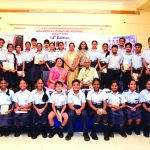
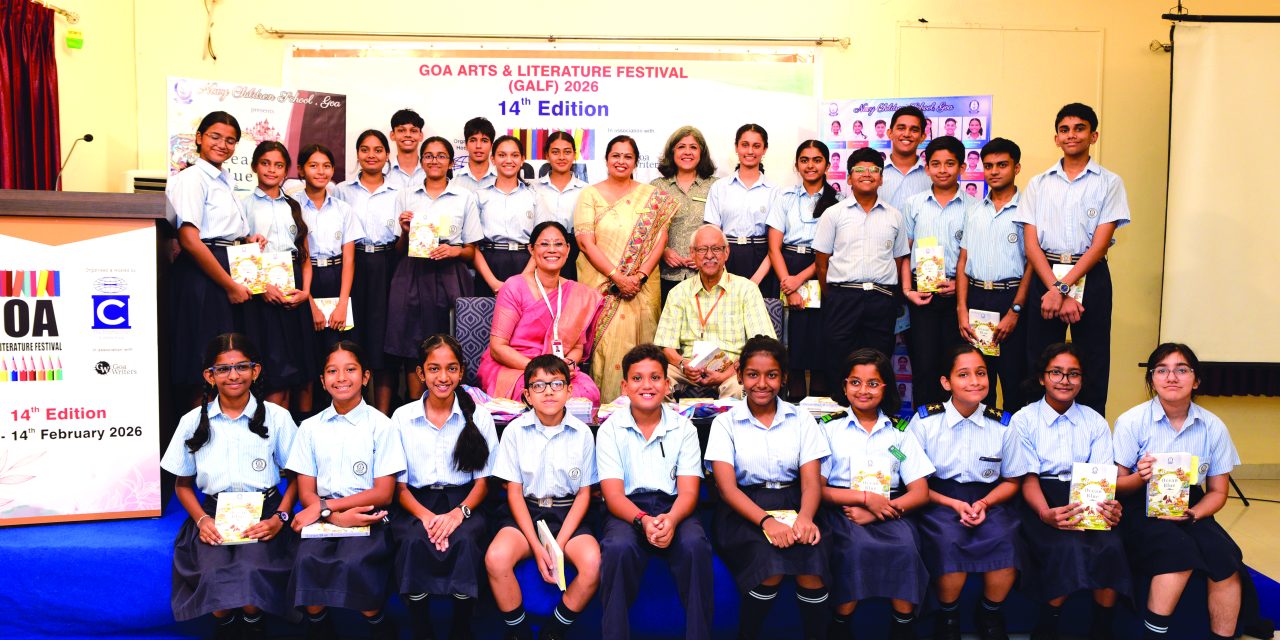
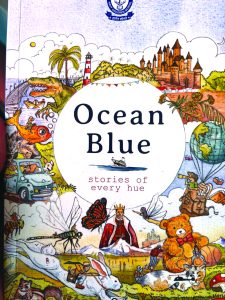
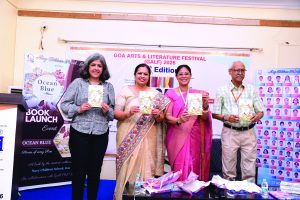
In an initiative to promote authentic creative expression among young learners, Navy Children’s School Goa recently released its second student-authored book, ‘Ocean Blue – Stories of Every Hue’, at the Goa Arts and Literature Festival by Konkani literary stalwarts, Jnanpith award winner Damodar Mauzo.
The anthology has 26 short stories written by students from Classes four to 12, aged between eight and 17 years, with 44 student illustrators contributing artwork. The stories span genres such as fantasy, science fiction, thriller, emotional narratives, parent-child relationships and ghost stories.
Principal Anupama Mehra shares, “Children usually write only for exams or school tasks. We wanted to give them a real platform where their voices could be heard beyond the classroom,” she says.
The project was undertaken in collaboration with Delhi-based publishing house Quill’s Club Writers, with whom Mehra had previously worked during her earlier tenure with a Gurugram school. “.After I joined Navy Children’s School Goa in November 2019, I felt we should bring the same opportunity here. Post-COVID-19, we invited them and that’s how this journey began,” she says.
The school’s first anthology, ‘Brimming with Tails – Goa in My Veins’, was launched in 2024. It had 21 student authors and around 40 illustrators. “When we saw the enthusiasm generated by the first book, we knew we could take this forward with a second one,” says Mehra.
The selection process for the latest anthology was conducted across the school and was open to all eligible students. “It wasn’t a conventional test. We gave creative prompts to assess imagination, originality and language skills. A link was created on the school website, and students submitted their entries. We shortlisted them in stages until we arrived at the final 26 authors,” she explains, adding that illustrators were selected through a similar process using creative drawing prompts. “A joint panel comprising representatives from Quill’s Club Writers and members of the school’s English Department evaluated the submissions.”
The publishing journey lasted six to ten months, beginning around July-August. Students went through multiple drafts and rewriting sessions under the guidance of mentors from the publishing house, who conducted workshops in Goa. “It was a complete publishing experience. The children even developed their own author profiles,” says Mehra.
To maintain originality in an age of Artificial Intelligence, the school enforced a strict no-device policy during the writing phase. “Students wrote their stories from scratch using only pen and paper before any digital work began,” she says, adding that editorial changes were minimal to preserve each child’s voice. “We did not change much at all. In fact, if we tried correcting them excessively, they would protest and say, ‘This is not my story’. They were very clear about what they wanted to express.”
Each story was illustrated by two or three students who worked with the author. Mehra describes the collaboration between writers and illustrators as one of the most rewarding aspects of the project. “They constantly refined each other’s ideas. The sense of ownership was wonderful to see,” she says.
Explaining the title, Mehra says ‘Ocean’ shows the school’s identity under the Navy Education Society network. “As a Navy school, you will always find a connection to water in our books. It is part of who we are,” she says.
Vice principal Sonali Mukherjee says the initiative is in line with the vision of the Central Board of Secondary Education. “We are a CBSE school and the board has introduced the CBSE Budding Authors programme to encourage writing. After our first book, many students participated and one of our authors was recognised,” she says.
She adds that the project also supports the National Education Policy’s focus on communication and writing skills. “Through such initiatives, we are helping students become confident writers,” says Mukherjee.
Mehra also highlights the importance of nurturing writing skills in the digital age. “AI-generated content often sounds doctored. There are certain phrases AI frequently uses and an experienced reader can identify it. Children must learn to express themselves independently,” she says, adding that strong grammar, vocabulary and clarity of thought are essential, especially during examinations.
The school runs a structured reading programme and offers creative writing as a formal subject at primary and secondary levels. “We start young. Reading is becoming a declining habit and encouraging children to read and write is more important than ever,” she says.
Headmistress Naazli Shah says that nurturing writers starts at home with the right environment. “Children should grow up around books and engage in conversations about stories and current affairs. Creativity cannot develop if learning is limited only to textbooks,” she says. She adds that reading also helps students manage stress.
Speaking about the students’ response to being published, Shah says they were excited. “The first time, they were nervous as it was new. This time, they were more confident and better prepared,” she says, adding that two authors from the previous anthology were selected again through a written test and interview conducted by the publishers.
Urging other institutions to create similar platforms, Mehra says schools need not wait for ideal infrastructure. “Start wherever you are. Even small steps can make a difference,” she says.
“We went through a selection process where we were given different scenarios and had to write stories based on them. After that, there was an interview round and then we were selected. A mentor from Quill Club Writers trained us on how to write and structure a story, and the process lasted for 10 days. Overall, it was a wonderful first-time experience for me. I realised that I’m more creative and imaginative than I thought. At first, I wasn’t confident, but the constant encouragement helped me realise that I could do it.”
- Asrit Pasricha, Class 8
“This is my first short story, and the whole experience has been amazing. I really enjoyed working on it and seeing how everyone on the team brought their own ideas to reality. My story, ‘Two Sides of the Same Coin’, is about a girl named Maya and her other self, Kay. Maya doesn’t know Kay exists but Kay tries to get her attention through impulsive actions. In the end, the story explores the fascinating depth and power of the human mind.”
- Swara Pande, Class 10
“My story ‘All Over Again’ is based on the fact that we cannot change our mistakes, we can only make our future better. The story is about a boy who hits someone while driving to work and feels very guilty. He meets a man who promises he can fix the past with a time machine but he soon realises that the past cannot be changed. The last line is very important to me because it sums up the story’s main idea. Writing this book also taught me that I can write more than I thought and that I can express my ideas clearly.”
- Auritro De, Class 12