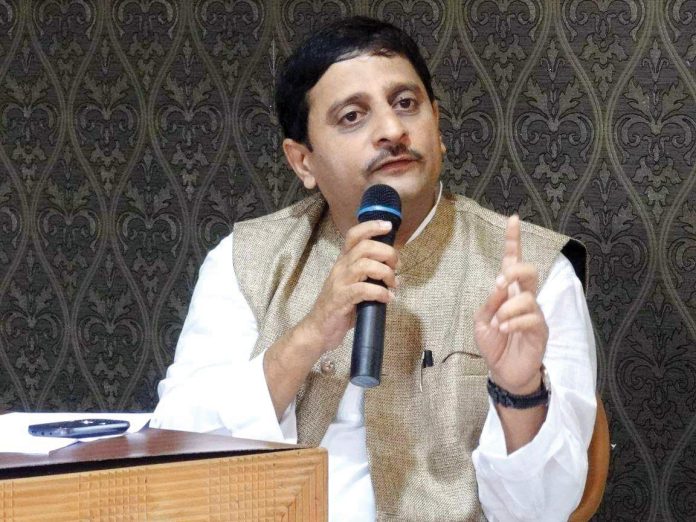
Educationist Dr. Bhushan Bhave is releasing two books— in Konkani, ‘Khann Vevsayachar Adarit Sahitya’ and in Hindi, ‘Khadan Vyavsay par Adharit Sahitya’ based on his study
KALYANI JHA | NT KURIOCITY
Principal of Vidya Prabodhini College of Commerce, Education, Computer and Management, Porvorim, Dr. Bhushan Bhave is releasing two books, ‘Khann Vevsayachar Adarit Sahitya’ and ‘Khadan Vyavsay par Adharit Sahitya’ in Konkani and Hindi respectively. These two books are based on Bhave’s research work during his doctorate research in Konkani which was conducted under the guidance of retired professor Chandalika D’Souza at Goa University.
Bhave, also a lexicographer has previously published a 350-page Hindi to Konkani learners dictionary. A translator and recognised panelist of Directorate of Official Languages he tells us: “My PhD thesis is in Konkani, so I preferred to publish a book in Konkani. Also, most of the books that I researched to understand mining were more from the Hindi-speaking northern belt, Jharkhand, Uttar Pradesh and even West Bengal. Thinking that these books will be relevant and could have demand in the Hindi region, I chose Hindi.”
His research work was more focused on Goa’s mining regions. Besides, he studied novels, read short stories and a drama and films on mining. More than 42 novels based on gold, coal, iron and manganese mining throughout the world were analysed and nine representative novels based on mines were studied in detail as part of the research by Dr. Bhave. Of these nine, three novels published between 1977-1983 depict mining activities only in the state of Goa. These nine novels have been thoroughly discussed in Bhave’s books.
“It is said that, once upon a time, mining was the backbone of the Goan economy. It helped people to rise from their poverty level. People who could not afford a meal were able to build houses and own trucks. But the loss through mining is unrecoverable and that is the outcome of my study,” shares Bhave.
It was the Portuguese who introduced manual mining in Goa in 1951. As the government lost control of mining after 1990, the agencies and miners had the final say and were a strong lobby, explains Bhave. “Agriculture was destroyed, water resources were depleted, addictions were on the rise and people gave up their traditional occupations. There was labour unrest in Goa, which was not there in an otherwise peaceful state,” he says.
The books have six chapters that explore mining discussed in various literature over the years. He specially mentions chapter 6 where he discusses the destruction in five Js, i.e. Jan (people), Jal (water), Jameen (land), Jungle and Janawar (animals). These five elements have been affected and destroyed by mining activities over time.”
He also discusses the titles of the novels he has explored in studying mining that is self-explanatory about the effects of mining. “There was one Konkani novel ‘Acchev’, which was translated by Vidya Pai in English, as ‘The Upheaval’. There was another ‘Homkand’, which literally means to put something in fire and ‘Uddhwasta’ which means destruction, which is actually about how mining has brought destruction,” says Bhave.
It took 20 years after the Portuguese introduced mining in Goa in 1951 for writers to know the effects of mining on Goan society and culture. “Novels which I have taken up for study were written in 1970s, like ‘Acchev’ by Pundalik Naik. But today the problems that we face in Goa after all these years, especially in villages of South Goa, were well forecasted in 1970. That is how a writer is like a visionary,” he says.
Bhave suggests the findings of this study will be helpful while formulating future policies regarding mining in Goa. Bhave says that the writer always stands on the shoulders of society and can foresee what the society will be.
“In many countries, sustainable mining has been put into practice. But in Goa, is sustainable mining a possibility or not, is the question,” says Bhave.
Bhave has concentrated the matters of his thesis in the books according to the interests of readers. “Literature can give us insight to study the matter, how people should behave, the importance of gram sabhas and the need to be active and ask questions,” he says.
After submitting his thesis in 2015, he started working on the book in 2018. “At the submission of the thesis there isn’t as much awareness, but it is during printing of the book, that one has to be careful and sensitive as even a sentence might create some chaos in society,” says the author, adding that this is why it took four long years to complete the books.
Financed by Goa Konkani Akademi, the book will be released by minister for social welfare Subhash Phaldessai.