
Madhav Gopal Kamath became the first Indian to claim a major international Scrabble title when he won the 2025 Youth World Scrabble Championship. He shares his journey to his triumph
MARIA FERNANDES | NT
Madhav Gopal Kamath’s journey to winning the 2025 Youth World Scrabble Championship in Kuala Lumpur, Malaysia, began at the age of six, playing Scrabble with his father. Now 14, he has made history as the first Indian to claim a major international Scrabble title. Competing in the under-18 category, he triumphed among 218 players with an outstanding record of 21 wins in 24 rounds. Already the reigning national champion across all age groups, his victory marks a significant milestone for Indian Scrabble.
“I used to watch my father play Scrabble with his friends and my uncle, and the game fascinated me. Eventually, I learned the basics and started playing with my brothers and father,” says the youngster, who resides in Delhi.
His passion for reading, he shares, gave him a natural advantage in word games. “I remember solving simple crosswords and similar puzzles with my grandparents even before I turned five,” he recalls. “Another reason I took to Scrabble early is that it’s as much a math game as it is a word game. I could easily handle the basic arithmetic involved and quickly grasped the probabilistic elements. It wasn’t that I had any special talent; it’s just that I started learning all these things earlier than most people do.”
What started as a fun pastime gradually developed into a competitive pursuit. Around the time of the COVID-19 pandemic, he began studying the game seriously, which quickly paid off with consecutive runner-up finishes at the World Youth Scrabble Championship (WYSC) when it was held online. His rapid progress saw him break into the top 10 rankings in India, and in 2024, he clinched his first national-level title in Goa, followed by a victory at his home tournament in Delhi. Today, he holds the impressive position of being ranked fifth in the world.
Preparing for tournaments demands a high level of discipline, and Kamath’s go-to method for word study involves using apps like Zyzzyva; a software tool that quizzes players on targeted word lists. “It’s a much more structured approach than simply reading the dictionary, since the word lists are organised by probability rather than random order,” he explains. “The process is very mechanical, I mostly learn words through repetition. Eventually, the words stop feeling like vocabulary and start to become useful letter combinations. Still, I make an effort to learn as many meanings as I can, since I find that actually helps with remembering them.”
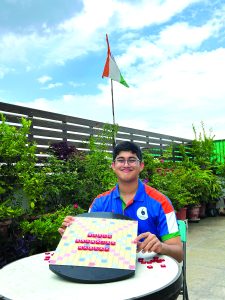
Both memory and strategy are crucial at the highest levels of scrabble and Kamath who devotes 30 minutes to an hour daily to the game through online apps; believes that the role of strategy is often underestimated “Strategy is worth more than word knowledge. I would say it is one of my biggest strengths and is how I am able to beat players who know more words than me,” he shares.
His biggest takeaways have been the importance of staying focused and remaining calm under pressure along with board vision. “Over time I’ve become much better at keeping my cool when the stakes are high and it’s evident in my game play. Another skill I pride myself on is my ability to make inferences based off of my opponent’s moves, which is very important at the highest level,” he says.
Winning and losing is all a part of the game and Kamath takes the time and opportunity after a disappointing finish to analyse his game and reassess his style of play. “Every game no matter the outcome has helped me grow and refine my approach. Honestly, I don’t think I’d be where I am today without those experiences,” he says.
For aspiring scrabble players in India, Kamath recommends starting by joining a local scrabble club and registering with the Scrabble Association of India. He believes this is one of the best ways to step into the competitive scene and connect with fellow players. “To improve at any level is simply to play regularly, even online, if offline play isn’t an option,” he explains. “Especially in the early stages, playing a few games every few days helps you develop a natural feel for the game that studying alone can’t provide. Once you begin studying word lists, regular game play not only reinforces what you’ve learned but also gives you a clear sense of your progress. Personally, I try to balance my time between playing and studying words.”
He also suggests two main tools to study: Zyzzyva (or a similar cardbox system), and Aerolith. “For Zyzzyva, you’ll want to focus on doing 7 and 8 letter words, in order of probability. In Aerolith, the daily challenges for 3, 4 and 5 letter words, the Word Builders and the High Probability Toughies are the most important lists. Doing the standard 7 and 8 letter lists here is inefficient because most of the words here are very low probability,” he explains.
Looking to the future, Kamath has his sights set on the ultimate prize; becoming the WESPAC Champion in the adult scrabble world. “That dream is still a bit down the road,” he admits with a smile. “Right now, my focus is on sharpening my skills and hopefully, defending my titles at the National Championship and the World Youth Scrabble Championship (WYSC).