
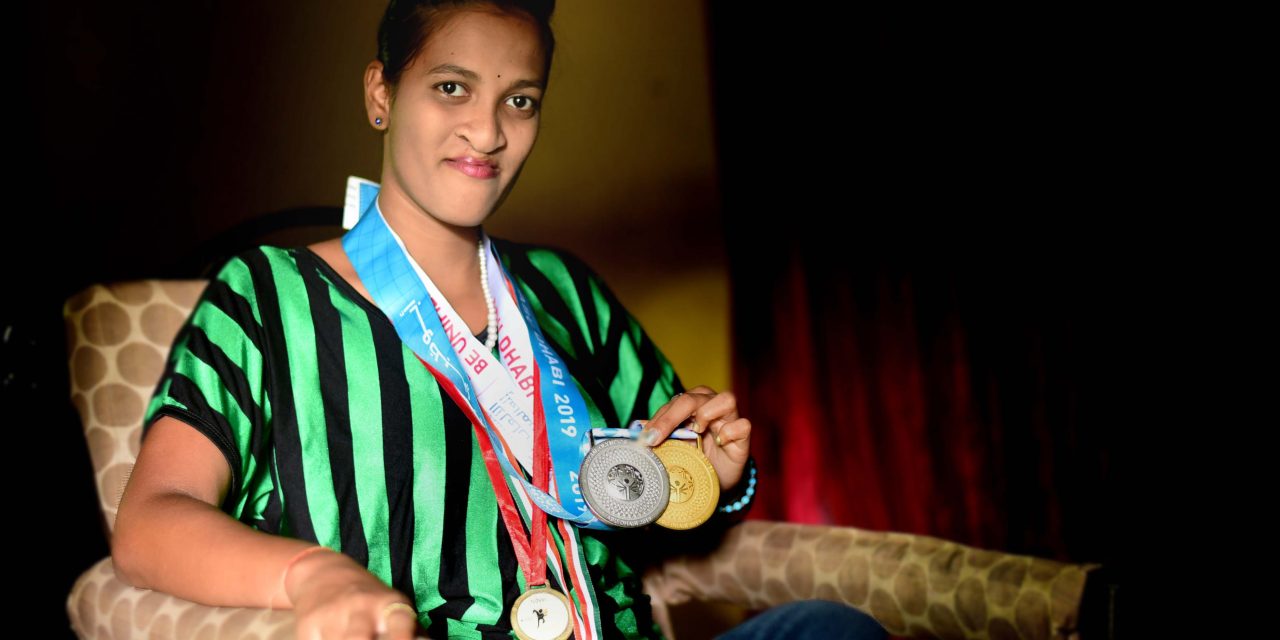
At the 2019 Special Olympics World Games, 17-year-old Sabita Yadav from Goa won a gold medal in the singles table tennis event and a silver medal in the doubles. What stands out about the teenager is that despite an intellectual disability, speech impediment and the fact that she took up the sport only in 2015, she hasn’t let these obstacles come in her way. Sabita shares her story with NT KURIOCITY
Maria Fernandes | NT Kuriocity
Growing up with a congenital cleft palate, Sabita had difficulty in speaking and conversing with those around her was not easy. “Since my speech was not clear, people did not understand what I was saying and I had to often repeat myself,” she says. To add to this, she also has an intellectual disability which prevented her from going to a regular school.
Coming from a family with financial difficulties, Sabita had to contend with other obstacles too. “Since my mother is a single parent and I also have a brother, it was difficult for my mother to make ends meet. She used to work as a domestic help and do ‘jhadoo-pocha’ for a living,” she says.
However, realising the importance of education, her mother admitted Sabita to Peace Haven School in Caranzalem. A special school, Peace Haven provides vocational training for older kids with intellectual disabilities. “The school had a different environment from what I was used to. My mother opted that I board there as it would be easier for me and her. I did miss home initially but I knew that it was for the best. Here I have learned many things like sewing, pottery and cooking. Also I have many friends now,” she says. Sacrifice she says is important to achieve something in life.
Besides the various vocational subjects, Sabita was also introduced to sports like badminton, table tennis, etc. However, it was table tennis that she gravitated towards and says: “My local coach Ritesh introduced me to table tennis and it was definitely more fun.” Her prowess at the game was soon evident and her name was put forward for the Special Olympics. A significant fact to note here is that the Special Olympics are similar to other international games where athletes have to go through the levels – clearing district, state, national and only then do they get selected for international competitions.
What followed for Sabita was hard work coupled with the determination to excel in the sport to the best of her ability and in the process better the situation of her family. “When I wasn’t living at the school I had to travel nearly an hour every day to Panaji to practice which was for about four hours,” she says as she explains some of the obstacles she had to contend with. “It was also tiring and I had to take breaks while practicing but I wanted to compete,” she adds. With the help of bare minimum explanations and many visual aids, she was soon ready and raring to go. Winning her medals, she says, was a dream come true.
Appreciation and gratitude are high on Sabita’s list and she thanks all her teachers, coaches, nuns at her school, the Special Olympics Goa board and STARS, an NGO that helped her on her journey. “It is important to not give up and pursue your dream no matter who you are and where you come from,” she says.
(Pic by: Hemant Parab)





Recent Comments