Panorama

18-05-13


AIRPORT AGONIES

By Adv Ramakant Khalap

Recent Census figures have many lessons for Goans. Lesson number one is that we allowed ourselves to grow like an oasis in an arid desert. We tom tommed our “uniqueness” - whatever that may be - of our culture, language, dress, food habits, and eulogised our love for “siesta” and “susegad”ness. We abhorred all sorts of hard work and manual labour and opted for greener pastures abroad. We invited the “bhaile” (outsiders) to come as tourists, labourers and investors. “Go – Goa – Go” we told everyone across the globe. And they came; they bought our lands and our conscience as well. Census figures tell us that they are inching towards a majority and may soon overtake us. Out of the approximate 15 lakh inhabitants of Goa almost 40 per cent comprise of the “bhaile”. Centuries ago Timaji, a general of Vijaynagar Kings, had invited Portuguese to defeat Adilshah. He ended up losing his land as well as his faith. History perhaps is repeating itself. One Manuel Fernandes writing on Facebook laments:

“Go Goa Gone,

Sharant rigleat Donn,

Shindolki-Casino ontoskornan,

Goyant raunk lagona mon”


Roughly translated it reads:

“Go, Goa, Gone,

Cities are ruled by Dons,

Prostitution and Casinos have stabbed our hearts,

I wish I run away from this dirt as fast as I can”


Coastal Karnataka and Konkan Maharashtra are richly endowed with nature, perhaps in many more ways than Goa. They have, however, remained backward for lack of infrastructure and a media blitzkrieg beckoning visitors. Belgaum, Khanapur, and Halyal have long been ignored by Karnataka for fear that they may one day have to be ceded to Maharashtra for linguistic reasons. The areas beyond Kolhapur-Hubli meridian are drought prone. Poverty in these areas is endemic. Beyond this meridian in the north and east lie the BIMARU states. Goa “the oasis” with such a poor hinterland is a virtual El Dorado both for the scoundrel and the saint, the job seeker and the entrepreneur. 

Good infrastructure is the surest way of unleashing rapid development. Due to poor infrastructure North Goa has by and large remained backward compared to coastal South Goa. Deep South and Eastern hilly parts are also under-developed. Dabolim Airport, Mormugao Port, and Railway Junctions are at Verna and Margao as well as one of Asia’s very large Industrial Estates is at Verna. Five and seven star hotels are a monopoly of the south. No wonder South Goa has been heavily urbanised. Jopadpatties or shanty townships have sprung up in Verna, Sancoale, Moti Dongor, Margao, Naveli, Vasco and many other places in South Goa. Most bhailes rush to South Goa because of its job potential. Mega Housing projects today dot the landscape of South Goa. Many more are in various stages of construction and planning. Almost 80 per cent of local and foreign tourists out of the total annual arrival of about 30 lakh tourists land up in South Goa. During peak season, south Goa is a babble of several Indian and foreign tongues. It is becoming increasingly difficult to spot a Goan in the maddening crowd.  Is it the wish of people from Salcete that all Goans and all non-Goans and all tourists, pimps, gamblers and revellers should descend in their villages and change the face of their villages beyond recognition? Identity of Salcetekars is already under serious threat. Do they want to compound this malaise?

Yes, Mopa may also help south Maharashtra. We should welcome this unintended by-product as it may thwart the influx of people to some extent. Mopa makes economic sense to North Goa as it will promote its development. It makes economic and social sense to South Goa as well as it may decelerate the rate of congestion of south Goa.

A new clamour for “special status” has just begun. Raison D’être for this movement is the fear of Goans becoming a minority within Goa. It is advisable, therefore, to allow the growth of our neighbours. Mopa in North Goa will help it; Chippi in South Konkan Maharashtra will accelerate it. There are airstrips in Belgaum, Hubli and Dharwar. These should become full-fledged airports. Karwar too should have an airport in course of time. And of course Dabolim must continue. Government of India is not a fool to spend a thousand crores and more to convert Dabolim into an International Civil Airport. And just as civil aviation will have two airports in Goa, Navy too may use both Airports in future.

And a last thought for the Aviation aficionados. At the THINKfest held in November 2012 by the Tehelka Group at Hotel Grand Hyaat, Bamboli, a wonderful presentation of flying cars was made by the inventor and pioneer of this type of aircraft. Just as mobile phones descended upon us like an avalanche, flying cars too are going to be the simplest and cheapest modes of aviation and driving in the very near future. They will fly on air routes guided by satellites, lasers and internet.  Numbers of personal jets and helicopters are steadily increasing. It is better, therefore, to provide two airports and a few more airstrips in places like Canacona and Dharbandora in Goa and places like Karwar, Gokarn, Halyal, Khanapur,Gadhinglaj, Malwan, etc. Salcetekars have in the past opposed fishing trawlers, Konkan Railway, widening of national highway, etc, and ended up embracing whatever they had initially opposed. It is now the turn of Mopa. And I bet the Salcetekars who are in large numbers in foreign lands as well as in places like Mumbai, Delhi, Bangalore and Calcutta will prefer to land at Mopa and be driven home along the proposed Super Express Way connecting north to south.

Meanwhile let the Alemaos, Vijays, Alinas and their elk enjoy the glare and publicity brought by their agitation in their otherwise insipid political lives.

18-05-13


By Vijai Sardesai

As the Manohar Parrikar-led BJP Government goes ahead with the Request For Quotation (RFQ) from companies interested in developing the Mopa International Airport in its quest to bulldoze the project against the wishes of the Goan populace, the public voice has grown in volume and substance. The “Goans for Dabolim Only” meeting at Lohia Maidan on May 15 saw Fr Eremito Rebello term Parrikar’s fast tracking of the airport as “dadagiri”. The wheel of the “anti-Mopa” agitation has turned full circle. During the tenure of the last government, a then minister opposed the government’s pro-Mopa view. What we saw at the Lohia Maidan meeting was no different. Two ministers and two ruling MLAs made a desperate attempt to identify themselves with the anti-Mopa sentiment, but ironically they rode to the meeting in their red-beaconed official government cars to attend a meeting that condemned the same government pro Mopa stance. What makes it even more ridiculous is that while Mr Digambar Kamat as chief minister took no proactive step for the Mopa airport, with the exception of denotifying the parking land at Dabolim airport, the present ruling dispensation is in an unholy haste. The stink of a scam is evident, and to borrow from Shakespeare, “something is rotten in the Taluka of Pernem.”

The Forest and Environment Minister is trying to sidetrack the anti-Mopa movement by highlighting the late Matanhy Saldanha’s view that the Indian Navy was illegally occupying Dabolim, while waving a clutch of papers that she says is proof. Sadly, she has not yet had the time to look into her files to find out whether her late husband had changed his opinion that “Mopa airport is a scam to eliminate Goa”. I had been told by the Chief Minister (CM) on the floor of the House that he had spent half an hour with the late stalwart, seemingly insinuating that Matanhy had changed his stand on Mopa before his death. But now Fr Eremito, a long time friend of Matanhy’s, categorically states that Matanhy, till his last breath, was an opponent of the Mopa airport because he sincerely believed that this would spell doom for Goa. Instead of asking for the Navy to quit Dabolim, which task borders on the impossible, it is a commendable stand that Fr Eremito has taken - that of a conciliatory approach of talks with the Navy to hand over certain land which could allow for the required expansion of Dabolim airport. I also want the CM, in view of Fr Eremito’s revelation, to reveal the truth about his confabulations with the late Matanhy. Or will I have to wait for the Government’s reply till the next Assembly Session? Mr Parrikar plans to hoodwink the people of a particular community by naming the South Goa Collectorate Building after the Late Matanhy Saldanha without scrapping ‘the scam’ of the Mopa Airport. Hence Goemkars demand that the Government first scrap Mopa and then name the majestic building after the late Matanhy, and thus keep his legacy alive. The illustrious son of Goa would definitely have preferred Dabolim only.

As is known to all, Dabolim is centrally located and Mopa, which is at the northern tip of Goa, will benefit the neighbouring state of Maharashtra and its hotel and real estate lobbies more than the people of Goa. With the present airport getting a brand new passenger terminal and a parallel taxiway, both of which are already in the pipeline, the handling capacity of Dabolim would go up to nearly four times the number handled last year. Further expansion with the co-operation of the Navy, which could be executed during the next five years or so, would ensure that Dabolim would meet the needs of Goa’s air traffic forever. The need for Mopa will never arise. The Government’s assurance that Dabolim will continue as a civilian airport even after Mopa is commissioned is a deliberate fraud being perpetrated on the people of Goa to cater to certain vested interests. These consist of powerful lobbies from outside Goa and even from abroad, who have invested in land around Mopa and are waiting for the airport to come up. Land has been bought at dirt cheap rates through local agents and politicians, among whom the surnames of Congress and BJP politicians figure prominently. Once the actual non-Goan buyers take possession of these huge tracts of land, the “special status” that is being sought so vehemently, will become a not-so-funny joke.

A quick scan of the all issues underlying the Mopa versus Dabolim argument reflects the fallacy that Mopa will benefit Goa. The International Civil Aviation Organisation (ICAO), a United Nations specialised agency, was commissioned by the government of Goa, in 2007, to study the feasibility of operations of Dabolim and Mopa airports. Their report categorically stated that a dual airport scenario is a second best solution after a single airport operation. An earlier ADPi study of 2005 had concluded that Mopa airport would not be financially viable even if the total traffic of Dabolim were to be shifted there. The ICAO report adds that splitting traffic between Mopa and Dabolim will make both airports unviable. The ICAO report, considering the distances between Mopa and other parts of Goa, especially in the south, had made an expressway across the length of the state a pre-condition for starting the project at Mopa. This expressway would only be an addition to the approximate 6,000 crore Rupees envisaged as cost of the Mopa airport. Contrast this with the 800 crore Rupees, at the most, which the terminal and taxiway at Dabolim would cost. The proximity of a sea port and railway junction to Dabolim makes it a better option for travellers to choose from these options. It has also been reported that a study by the defence services had termed the Mopa airport site unsafe. 

The government has not taken any steps to investigate this aspect, even though I had raised a question on this in the last Assembly session. The Mopa airport project has seen the largest single acquisition of agricultural land in Goa - of more than 80 lakh sq m. On one side, the Government talks of Special Status for Goa to protect land ownership of Goemkars and on the other hand dispossess Goan farmers of their land for a pittance. The BJP’s election manifesto, the much publicised Vision Document very clearly states that if Parivartan is ushered in PPP projects would not be allowed if 80 per cent of the land is not bought by the private party promoting the project. In the case of Mopa, although the project is not mentioned in BJP’s manifesto, 80 lakh sq m of land or more has been acquired for a pittance to benefit a private party (most probably a non Goan) to develop ‘the greenfield’ airport, which in essence means a PPP mode of development. The hasty acquisitions even when the Land Acquisition Bill is in the final stages of the coming law indicates huge pecuniary interest of the Government and the spectre of election funds for approaching Lok Sabha polls being mobilised as lobbing fees for the project cannot be ignored.

The Government has tried to hide behind a screen of lies. Misinformation about the land being barren and uncultivable and uninhabited is being spread through all means. A pittance of Rs 35, or thereabouts, per square metre has been paid to farmers as compensation for taking away their livelihood.

The present Government, led by a person who had termed the Dabolim airport parking land denotification as a scam on the floor of the house during the tenure of the past government when he was opposition leader, made a dramatic U-turn and allowed the land acquisition to lapse and make a writ petition in the matter infructuous. Subsequently the same scam was legitimised and even justified with the same lies as were tom tommed by the previous dispensation.

I, as convenor of “GOEMKAR”, and later on the floor of the house, had asked the Government why it was in a devilish hurry for Mopa airport when it was clearly not in the interests of Goans. I had then been criticised by the Treasury Benches for trying to divide Goa on a North-South basis. All ruling MLAs were seen thumping their desks in support of this mischievous allegation. Four of these desk-thumpers were present at Lohia Maidan on May 15. I am happy that they have, better late than never, realised that I was right. I have always maintained that the Mopa-Dabolim issue is a problem created by politicians and that only a political solution can resolve it. The Lohia Maidan meeting, regrettably, lacked a political message.

But it is not too late. The four ruling MLAs, who have seen light, should convince their like-minded colleagues and demand that the Government listens to the peoples’ voice and scraps the Mopa airport immediately. If not, they should step down from the posts they occupy, as people will demand that they choose between Dabolim and the chairs they occupy. Only then will they be seen as true supporters of the cause. Their choice is between being with the people or supporting a Government that cares a fig for the interests of Goa and Goans.


18-05-13


By Karan Thapar 

As we await the election results from Pakistan — and I believe we should have a clear idea of the outcome before the day is out, even if the outcome is not clear! — Let’s pause and consider what sort of campaign it’s been. This was for many reasons a litmus test for Pakistan. And it’s passed it creditably.

That deserves recognition.

First, it’s been an exceptionally, actually an unprecedentedly, violent campaign. 

Declaring “We are not in favour of democracy”, the Taliban threatened to bomb the electoral rallies of secular parties like the PPP, the MQM and the ANP. By one reliable count, on an average 10 to 15 people were killed daily. As Bushra Gohar of the ANP put it: “This is pre-poll rigging”. You could hardly disagree.

Yet that didn’t deter candidates. They found ways, effective or symbolic, of overcoming this hurdle. In the process some martyred themselves for the cause of democracy. 

As Najam Sethi, the caretaker chief minister of Punjab, explained, there was no alternative. If Pakistan had waited for the terror to end elections would never have happened. Yet it takes extraordinary guts and deep commitment to campaign in these conditions.

This violence could also put voters off. In fact the Taliban have specifically threatened women who come out to vote. But if Pakistanis turn out in larger numbers than before — and there’s a real expectation the turnout could exceed the previous average of 44 per cent by a whopping 10 per cent — it would prove, or at least corroborate, the thought underlying this analysis that Pakistani democracy has not only responded admirably to this critical challenge but achieved a landmark of defiant commitment against daunting challenges. 

A second aspect of this election is that 40 million voters, 45 per cent of the registered electorate, may have voted for the first time yesterday. If you add to that the fact that 35 million previous voters have been struck off the register on the grounds they were bogus, you end up with a virtually unknown electorate. 

That makes the outcome both unpredictable and exciting.  Now the vast majority of Pakistan’s voters are under 35. A huge section is actually under 25. A recent survey shows that 94 per cent of these people think Pakistan is going in the wrong direction, 77 per cent approve of the army, 74 per cent are inclined towards religious organisations. Will they vote for the Sharifs and Zardaris, who have disappointed them repeatedly, or plump for Imran, a new if risky choice? For us in India there is a special feature that deserves attention. The Kashmir issue was virtually missing.

As Najam Sethi told me, the Pakistani people no longer see Kashmir as an obstacle to the improvement of Indo-Pak relations. We need to recognise that. He also added that the army no longer sees India as an existential threat. At the least, we need to test that.

We also need to learn a lesson from Pakistani politicians. They readily give interviews to Indian journalists. 

Nawaz Sharif, in fact, spoke with winning candour. Unfortunately, our politicians don’t give interviews to the Pakistani press.

How can we expect a better understanding of our interests and concerns in Pakistan if we won’t speak to their media and thus deny the Pakistani people the right to hear us? If Najam Sethi is right, the Pakistani people have changed faster and more comprehensively than their politicians.

We will deny ourselves the benefit of this shift if we don’t respond to that fact. HT Media

18-05-13


By Victor Rangel-Ribeiro

Consider the plight of the American Airlines woman passenger who was so much in love that she could not stop singing about it. Love is a joyous feeling, a contagious feeling so powerful that lovers feel they could transform the world, if only they can make others see what wonders love has done for them. The AA passenger certainly seems to have felt that way, but since neither American Airlines nor the press have told us her name, let me call her Ms Solo Mio. What she did must be appreciated, rather than criticized. Hers was truly a heroic solo effort.

With typical journalistic carelessness, the press has given us some tantalizing information, but left out even more titillating details, which would have provided us with psychological and sociological insights that would have helped us to understand her motivation. Fortunately there’s a whole tribe of scribes known as columnists, to which tribe I belong, who feel it is our duty to understand the unknowable, and to explain the inexplicable, and it is in this role that I bring you my column today. 

Here are some questions that quickly come to mind; follow me, this is important. True, Ms Solo Mio was in love; but was she singing merely to inform the plane’s passengers as a group, or was she serenading one person in particular? If one person, was that person male or female? Young or old? Crew member or passenger? You see where I am going?

Did the object of Ms Solo Mio’s singing object to her singing, or to her interpretation of the song? There’s a subtle difference here! Or was it somebody else who did the objecting, a curmudgeonly old spoilsport who had never been in love? Would such an older person have been mollified if she had switched from singing Whitney Houston to singing Bing Crosby? In singing Whitney Houston, and sticking to it, was the singer discriminating against not just one, but several older generations?

May I also point out that the reaction would have been far different had it been Ms Houston herself who was doing the singing. Unfortunately, Ms Houston passed away last year, so Ms Solo was at best a female impersonator. Another difference: Ms Houston, had she been alive, would undoubtedly have been travelling first class, and the sound of her voice would have been greeted with the clink of champagne glasses; Ms Solo Mio was probably travelling coach, where many more seats are crammed into each row, so there’s no elbow room, the rows are spaced close to each other, so there’s no knee room as well, champagne is never served, and tempers quickly flare.

American Airlines has claimed that she was “interfering with the flight crew.” Might the object of her undying love have been either the pilot or the co-pilot? If she was serenading the pilot, might that have made the co-pilot jealous, and if she was singing to the co-pilot, might that have enraged the pilot, because she preferred an underling?

History tells us how past captains have dealt with recalcitrant passengers; not just airplane pilots, but ship captains as well. British ship captains dumped thousands of undesirables in far-off Australia, but one Frenchman called Bonaparte was given preferential treatment, and given a whole island to himself, smack dab in the middle of nowhere. Pirate ship captains, on the other hand, never took unwanted passengers on protracted journeys; they just made them walk to the end of a very short plank.

Airplane pilots might want to imitate the “walking the plank” punishment, but luckily you cannot be made to “walk the wing”. Any attempt to open a window and push a passenger out would have disastrous consequences not just for the pushee but for the pusher as well, as also for the rest of the passengers and crew. No, no, far better is it to do what the AA pilot did, and bring the plane to a gentle stop on the tarmac at Kansas City. But why was Ms Solo Mio handcuffed? That would not have prevented her from singing! Did nobody have a gag? 

On the techno/scientific/human evolution side, we must not lose sight of the fact that Ms Solo Mio represents a tremendous advance in the history of the recording industry. She is the world’s first walking, talking, portable human record. While the old LPs could play at most for about 30 minutes a side, Solo Mio went on nonstop for three full hours, and was still good to go the rest of the day.  

In 2009, just three years before her death, Whitney Houston was recognised by the Guinness Book of World Records for being the most awarded artist of all time. Ms Solo Mio, while not in the same class as a singer, still deserves to be recognised for her achievement: she sang “I’ll Always Love You” while travelling over the greatest distance ever (from Los Angeles to Kansas City must be a good 1,000 miles) and at the greatest height about sea-level, since the plane was probably cruising at around 32,000 feet. And (this was the most remarkable part of the feat) Ms Solo Mio sang consistently off-key. How much more special can you get?

Now a word to the wise. When I was a teenager, and permanently but intermittently in love, I sang mournful love songs every day, because my love affairs always ended disastrously. But I did all my singing in the family bathroom, while having a shower. The sound of falling drops drowned out any pain caused by my very screechy singing. There are no showers on planes, but the toilets are made soundproof, for obvious reasons. Had Ms Solo Mio done her endless singing in the toilet, she would still have annoyed her fellow passengers, but for a different reason altogether.

While news reports merely state that she was handcuffed and led off the plane, nobody really reveals how long that process really took. I hope they gave her time enough to at least sing the first verse one last time, because that one is really relevant to her situation:

“If I should stay,

I would only be in your way;

So I’ll go, but I know

I’ll think of you every step of the way.”

Every step, every step, yes every step of the w-w-w-a-a-a-a-y-y-y-y-y!

18-05-13


By Barkha Dutt 

In Lahore’s Model Town, an unlikely contingent of guests trooped into the spiffy party office from where Nawaz Sharif runs his political campaign. Striding across the manicured green lawns in one single line, they were a cloudburst of colour. Magenta robes, saffron turbans, tailored black cassocks — religious representatives of Pakistan’s beleaguered minorities had come to meet the man they believe will be the country’s next Prime Minister.

In full view of multiple cameras, priests, bishops, granthis and even a pandit warned against the violent discrimination that their communities have suffered at the hands of bigoted fundamentalists. They told Sharif he had their political backing but reprimanded him for not coming down hard on party workers complicit in the recent burning of churches in the city’s Joseph Colony.

The former Prime Minister listened quietly, took notes and did not demur at the criticism. The man who could have a bash at the country’s top political job for the third time was reminded of the nuclear bomb that was tested on his watch.

“If you could build an atom bomb to protect us against India,” declaimed the pastor on stage, “why can’t you protect us against fundamentalists?” When Sharif finally spoke he quoted Punjabi Sufi poet, Bulleh Shah to make a point about religious amity. “Tear down the mosque; tear down the temple, tear down everything in sight. But don’t break anyone’s heart. Because God lives there.” He may have been billed as a religious conservative in his previous avatar, but in this election Sharif has positioned himself differently. 

As he moves from the right to the centre of the political spectrum, many are asking whether the man who uses the tiger as his election mascot is changing his stripes.

His tumble from power in Musharraf’s infamous 1999 military coup, years in prison and enforced exile have made him much wiser say critics and aides alike. Former minister and party colleague Tariq Azeem, who switched parties just last year to join Sharif’s campaign has a theory. “Every Pakistani politician should have to spend a decade outside the country. They come back much smarter,” he quips, only half-seriously.

Before she was assassinated, Benazir Bhutto and Nawaz Sharif were able to temporarily bury intense and historic rivalries in their years as banished politicians.

Those years of political maturity made the shift in Pakistan’s politics possible.

Nawaz Sharif’s economic philosophy is clear; he is a free-market proponent who is promising to put muscle back into a floundering economy.

His political ideology still remains somewhat ambiguous, leaving him open to the charge of being soft on militants.

He has advocated a dialogue with the Pakistani Taliban, a virulent terrorist outfit that is allied with the al-Qaeda and is responsible for killing thousands of his countrymen.

This has been a source of public disagreement between him and Pakistan’s Army Chief. The Pakistani military will not negotiate with the Taliban unless its extremists disarm and “unconditionally submit to the state, its constitution and the rule of law,” asserted Kayani, just last month.

But the compelling question thrown up by a possible victory for Sharif is how it might impact the civil-military equations in Pakistan. If elected in a historic civilian to civilian transfer of political power next week, Sharif could represent the first serious challenge to the sovereign control Pakistan’s army has always had over the political nerve-centre.

Of course Sharif was not always on the other side of the trenches. He started off as a protégé of the much-disliked general-turned dictator Zia-ul-Haq. Twenty-five years later he is reminding citizens that it is the prime minister who should be the military chief’s boss; not the other way around.

At the meeting with religious minorities, Sharif remembered the dictator who transformed his opinion of how much power an army chief should wield. 

Suddenly, and without preamble or context, he introduced the Indian journalists present at the meet and insisted that they come on to the stage.

Introducing us to the gathering, he lapsed into sentimentality about how India and Pakistan “used to be one country, with the same food, the same language, the same culture. It was a dictator who ruined the relationship in 1999.” Nawaz Sharif was prime minister when the Kargil war erupted as a result of Musharraf’s crazed misadventure, one that the General has refused to regret till this day. Not many in India are convinced that Sharif was entirely ignorant of the Army’s plans as he subsequently claimed. But enough Pakistanis make the argument that at least part of Sharif’s unpopularity with the Army is his soft stance towards India and his avowal to be the architect of his own peace process this time. He recently called for an inquiry into the Kargil fiasco, ruffling more than one feather in the security establishment.

Nawaz Sharif ended his effusive welcome to the Indian media with a public desire to visit soon, “if they invite me.” By Monday, his party is likely to emerge as the single largest formation. Yet, the murmurs in Pakistan are that he may still find it tough to cobble together a coalition. The reason, the whispers go, is that Pakistan’s army is less than fond of him.

The cynics say the military would prefer a government of other combinations including Imran Khan — Sharif’s main challenger in Punjab — as a sort of safety valve for public anger, but one they feel more confident of managing. Khan, presently strapped to a hospital bed has always rubbished allegations of being patronised by the military.

But whatever the outcome, this is an election that could be a test case for whether a real transfer of power takes place. Not only from Asif Ali Zardari to Nawaz Sharif or Imran Khan; but from the entrenched power of the military establishment to a genuine, if infant, democracy. HT Media

18-05-13


By Amosh Tripathi

We are going in the wrong direction!’ How often have we heard this in the recent past when talk veers to India’s future? There is an overriding and all-pervasive atmosphere of pessimism today. There are, no doubt, short-term political issues, and these have been analysed in detail by people far wiser in such matters than I can ever be. I’m sure that as a country, considering our voting record, we will find solutions to our political problems.

Let me focus instead on a longer-term issue in this article. It has been much lamented that the root of our governance problems is the coalition era we are forced to contend with. Even amongst rational, thoughtful people, there is a deep concern with the leaching away of power from Delhi to the states. We long for one-party dominance, because then, apparently, we will have results. Do I agree? Frankly, I don’t.

How many times has it happened in India’s history that some powerful ruler has stamped his mark over most of the subcontinent? Not often. In the last two and a half thousand years, more than 50 per cent of our land has been ruled by a stable centralised power for not more than 800 years: under the Mauryas, Guptas, Mughals, Marathas, British and the first 40 years post our independence.

There have been some ridiculous interpretations of this historical fact to say that India was never a country and that the British created it for us. This is pure nonsense. The concept of a nation-state didn’t exist anywhere in the world before the various treaties of Westphalia in the 17th century. In 16th century London, if you said you were loyal to England and not to King Henry, you would be beheaded as a traitor. In early and medieval history, countries existed as cultural and tribal concepts, not necessarily as political concepts.

Culturally, India was always one country through all of history.

Politically however, we were, more often than not, divided.

And that political division was our competitive strength, for it encouraged innovation, the most powerful tool for wealth generation. India was a hotbed of innovation through most of history, from millennia-impacting innovations like the place value of numbers and the philosophical concept of karma, to practical, earthy innovations in areas such as architecture, surgery, ship design and irrigation techniques. By its very nature, innovation is disruptive and rebellious. Our political divisions allowed our innovators and free thinkers to have options. If the Palas didn’t like your ideas, you could go to the Cholas. If the Tuluvas of Vijaynagar didn’t like your thoughts, you could go to the Bahmani Sultans. Since we were culturally one country, travel was easy.

Decentralisation helped innovation and kept us rich.

So can we argue the opposite? Does centralisation harm innovation? More often than not, yes, it does. A Chinese emperor, who ruled all of China with an iron hand, banned maritime activities just a few decades after Admiral Zheng He’s trailblazing 15th century sea voyages. Nobody in China dared to rebel against the anti-innovation decision of the emperor. The long-term impact was that it wasn’t Chinese ships that colonised the world, but European ones. Examples like this abound in India as well during our few centralised eras, for example the rejection of the Gutenberg press by Emperor Akbar (otherwise an absolutely brilliant ruler) or our suicidal economic policies from the 1950s to 1991. If India had been politically divided or decentralised at these times, these unfortunate decisions could have been challenged.

So a decentralised, messy and politically divided land is actually good for innovation.

The problem with political division, however, is the risk of violence and chaos. That has happened quite often in India’s history. But now, our democracy has given us the tools to manage these political divisions without the possible violence that comes with it. So I say let power go to our states; let the centre become weak. The stunning progress in some of our states will set up a demonstration effect which can trigger a very healthy competition between different chief ministers. Ruchir Sharma, the author of ‘Breakout Nations’ said that if you want to be pessimistic about India, go to Mumbai and Delhi. If you want to feel optimistic, go to the states.

The forced decentralisation that is happening in India today due to weak coalition governments is good for us. We need to strengthen that trend constitutionally — too many constitutional powers still remain with the Centre. They can’t get things done, but they can stop others from doing them. Many items from the union and concurrent lists in the constitution need to be transferred to the states list. If the states become constitutionally stronger, you won’t find regional parties wasting their time battling for sops from the Centre — they’ll actually spend their time governing their states. And our country will become a hotbed of innovation once again.

The ability to innovate is a far more potent and long-term competitive advantage when compared to raw efficiency. Ask America. Interestingly, the US constitution has focused on states’ rights, keeping the federal government relatively weak.

Equally interestingly, India’s modern, golden-economic period (post 1991) coincides with a political era when no single party has won a parliamentary majority on its own. Coincidence? I don’t think so. HT Media

18-05-13


By Patricia J Pereira-Sethi

Stefan Radstrom is not your average GM of a five-star hotel. He may run a tight ship at the fabulous Grand Hyatt Resort & Spa in Bambolim, but he is a man with a soul.  After all, he is a Swede, and what you can be sure to expect from Swedes is that they are fabulous folk.

They are probably the most endearing people that I have encountered during a life in New York which spanned four decades. My best friend was Gunnel Gustafson who taught me simple Swedish words like hej  for hello, ja for yes, nej for no and tack for thank you. Our first car in the US was a Volvo because my husband was convinced, and rightly so, that it is a solid, dependable buggy. It lasted forever and ever: we had to gift it away to a Polish immigrant friend to make room for the fancy German cars which followed. Our mechanic was Jan Nielsen, a Swede; he used to be a race-car driver on the US circuit before he set up shop on Long Island. Jan kept all our vehicles in tip-top shape. And the absolute favourite actress in the family was Ingrid Bergman, whose diaphanous eyes clinched our hearts and minds in movies from Casablanca to Notorious.

I have interviewed the late Prime Minister Olof Palme, who was assassinated on the streets of Stockholm while walking home with his wife, sans security, from a local theatre. He was a gentle and sensitive human being, a leader with a solid socialist streak.  Gunnar Myrdal talked to me about money matters and finance after he won the Nobel Prize in Economics, even as he reminisced about his wife’s tenure as ambassador to India, recalling the happy days he had spent in New Delhi. I conversed at length during a TV show with the breathtakingly beautiful Norwegian actress Liv Ullmann who, as an ambassador for UNICEF, enmeshed herself in the lives of impoverished children across the globe.

Like his Scandinavian compatriot before him, Stefan Radstrom has also left his imprint on Goa’s forgotten poor. He is the engine behind the Konkan Development Society’s Don Bosco School in Odxel, which educates marginalised children from nearby villages. The school handles pre-primary courses and has initiated the first grade this academic year—with an aim to upscale gradually to the tenth.  Currently, there are 89 children in the day program with 20 more being tutored during the evening.  I know this well because Khaja, the young son of my cleaning lady Fatima, studies there for free.

It was Stefan who nominated the Konkan Development Society for the Hyatt’s funding scheme. The chain’s philanthropic program empowers its associates around the world to propose deserving charitable organisations within their communities to the Hyatt’s head office for donations. Thanks to Stefan’s efforts, the Konkan Development Society’s Don Bosco primary school in Odxel recently received a check for US $10,000.

The award will be utilised to enhance the development infrastructure available to students: it will set up a library and a computer laboratory. It will invest in sports equipment and provide scholarships for financially-stricken students, as well as reward those who are performing well. Fortunately, Stefan is not the kind of benefactor who will pay the bill and ignore the rest. He and his fiancée, the tall and striking Russian beauty Svetlana Ostroshkina, regularly visit Odxel village to engage the children and reassure them that their future is secure.

Stefan Radstrom began his career in 1989 as a waiter in his home town of Ronneby. A year later he graduated to the Plaza in Oslo and in 1991 progressed to the Grand Hotel in St Petersburg, where he doubled as Restaurant and Hotel Manager. A decade later he became the Resident Manager of Le Méridien in Bucharest, transferring thereafter to the Regina in Warsaw. For three years, he administered the Grand Hyatt in Doha before relocating to Goa. In course of his career, Stefan has interacted with some of the world’s top personalities: George and Barbara Bush, Boris Yeltsin, Yasser Arafat, Michael Douglas and Luciano Pavarotti to name a few.

The Goa Hyatt is Stefan’s baby. He weaned it from a brick and mortar property, sculpted around a magnificent 17th century Portuguese palace, into a visually stunning beachfront hotel. Spread over 28 acres of lush foliage overlooking Bambolim Bay, the hotel boasts 314 guestrooms, sparkling outdoor and indoor pools, a spectacular spa and the largest event and banquet facilities available in Goa (which include a 1150 sq metre, pillar-free Grand Ballroom). Stefan kept a constant and watchful eye for over a year to get the hotel up and running: he supervised everything from the local bureaucracy to the hiring of a seamless staff which would make the hotel proud.

Stefan lives and breathes the Hyatt. He is its conjoined twin. His presence is evident everywhere: from a sudden appearance in the lobby to spot-check the guest list to a swift look inside the Dining Room to assess its functioning. He greets all his staff en route, animating them with a kind word or smile. He has broken down the hierarchical barriers which exist between bosses and workers: he has no qualms about bending down to retrieve a cigarette butt which some careless guest has flung onto the immaculate marble floors. “Money is only one aspect of the job,” says Stefan. “It is absolutely essential to me that the employees enjoy the workplace. I want them to believe that they are an intrinsic part of the Hyatt family.” At a recent national convention I attended at the Hyatt, his imprimatur was clearly manifest, from the impeccable service to the exquisite meals. Stefan Radstrom leaves little doubt that he holds sacred every aspect of Hyatt’s gracious hospitality code.

Stefan enjoys living in Goa and is full of praise for the friendly, smiling Goan. “Hospitality is in the blood of the people: they easily warm up to others, they like making others happy. In Eastern Europe people scarcely smile at one another; in the Middle East they treat everyone as a foreigner. Not here. In India everyone is proud of his culture and they make you feel welcome and respected.”  He has had little time to travel throughout the country given the 24/7 constraints of the job—except for a weekend trip to Agra to view the Taj Mahal and a brief holiday in the Maldives. But Stefan is a happy and contented man: his idea of relaxation is watching the sun rise and set on Bambolim bay with Svetlana by his side.

Skal Stefan!

18-05-13


By Maria de Lourdes Bravo da Costa Rodrigues

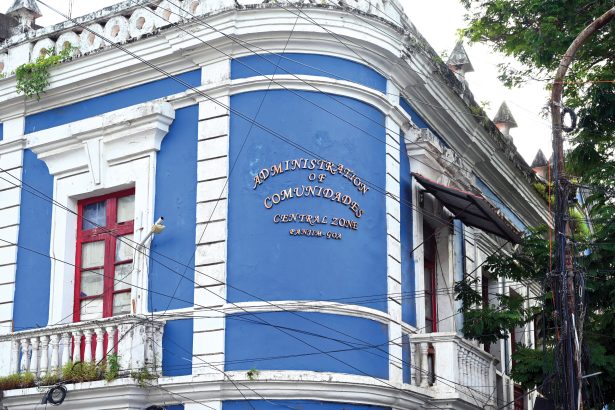
The romantic Latin ward of Pangim where boys serenaded their beloved through the evening and where groups of music lovers took any opportunity to go serenading through wards on their friends’ birthdays or any other occasion, was the first area in Pangim to be populated for residential purpose, even before it was declared the new capital of Goa. The inclination for this area was due to the availability of fresh drinking water, which trickled from a spring that was called ‘Fonte Phoenix’, from which the ward got the name “Fontainhas”. 

The first house built in the area was that of Antonio Joao de Sequeira. Later Adv David de Souza who hailed from Chorao and was the legal adviser to Mr Sequeira bought land from him and built a house. Another palatial house was that of the family of Fonsecas, where today functions the Fundacao Oriente.

When Pangim was chosen to be the new capital of Goa, some of the government offices started being transferred to Pangim and since the government staff needed houses to live in the city they applied for land to build houses. The ward was populated by different types of citizens, which included the Portuguese gentry, mestizos and Goans. There were in fact all types of people residing in the ward, from Portuguese government officers, officials, various professionals to students. People from different walks of life and from different parts of Goa lived in the ward. It must be mentioned that the ward had a haphazard growth without proper planning which has given it the characteristic look of having narrow lanes and by-lanes where houses touch one another’s wall.

A ward with such diverse population is bound to produce people who are known professionally in different fields from doctors, advocates, teachers, bureaucrats and others. A selective attempt is made here to list a few names that were prominent on the Goan scenario, and who have left an indelible mark as advocates, bureaucrats, businessman and writers, without offence to others who have not been mentioned.

Another important personality who lived in the ward and owned a beautiful house, which has since been demolished to make way for the unsightly structure of the People’s High School, was Filipe Nery Xavier. He left behind many books that throw light on the history of Goa and very importantly that of the village Comunidades of Goa. Having worked in the Government Secretariat as an officer, he made good use of his position where he had access to various documents. He left for posterity a long bibliography of books which includes ‘Bosquejo historico das Comunidades de Goa’, ‘Various government orders’, ‘Colleccao das leis peculiares das Comunidades agricolas’, ‘Resolucoes, usos e costumes que servem de leis regulamentares para o governo administsrativo, economico e judicial das provincias denimonadas das Novas conquistas’. He was also the editor of the periodical ‘Gabinete Literario das Fontainhas’ that throws light on many Goan aspects amongst others. He was the first Goan to be member of the Academia das Ciencias de Lisboa. He was also the founder member of the Instituto Vasco da Gama and member of various other literary bodies.

Fr Casimiro Cristovao de Nazare’s contribution to religious history is unsurpassable in ‘Mitras Lusitanas no Oriente’, a catalogue of the priests in the higher echelons of the church hierarchy belonging to the Archdiocese of Goa and its subordinate dioceses, and includes religious orders issued and summary of notable facts of the ecclesiastical history of the East. Also, facts on the history of the Portuguese Padroado and its war with the Propaganda Fide, and the history of the Religious Orders in the East and its influence on the society are well documented. To complement the Mitras he wrote ‘Clero de Goa’ a book on the Goan clergy and their contribution. Although he published more books quite a few remained unpublished. He was also founder member of the Instituto Vasco da Gama. 

Guilherme Dias who came from a small village of Badem in Bardez, due to his sheer persistence and foresight rose to become one of the richest businessmen, with varied business interests at the beginning of the twentieth century. He was the founder president of the Associacao Comercial de Goa. His house was donated to the sisters of the Franciscan Order which demolished the ancestral house to build the present Mary Immaculate High School.

Another scholar who lived in the ward was Jose Maria de Sa, who also left behind works on the Comunidades of Goa, And his introductory essay to the second edition of ‘Bosquejo historico das Comunidades de Goa’ is recommended for those who want to study the system.

We had an educationist in Prof Venceslau Soares who started his career as a primary teacher and rose to become an Inspector in the Department of Education, he left a number of publications on education and pedagogy not forgetting his interest on culinary art on which he also published two monographs. Incidentally, his wife Profa Lubertina was one of my primary teachers. I would like to mention that another of my primary teacher lives in the ward Ms Julieta Gomes da Costa e Andrade.

Writing about educationists I would also like to mention another teacher Prof Carlos Xavier who wrote not only on sports in Goa, but a number of articles on the history of Goa.

One cannot forget the contribution of librarian, Mr Aleixo Manuel da Costa, who’s ‘Dicionario de Literatura Goesa’ in three volumes is a must for any library with interests on Goa and for those who want to do research. 

Mr Nanu Pednekar a social activist of the time should take the credit that Fontainhas had a public library, Mahalaxmi Library, which completed its centenary in 2008. The main road up to the spring is named after Mr Pednekar.

Octogenarian Percival Noronha’s family settled in the ward from the 1930s having come back from Africa where his father worked. He joined the Portuguese government and after Liberation of Goa retired as Undersecretary Health having occupied different positions in the administration. What is to be appreciated about this gentleman is that although he was a bureaucrat he developed a love for history, architecture, furniture, and his acumen to learn gave him the proficiency on things Goan. He is today considered an authority on Goa and Goan things. I too knock on his door many times seeking information. 

It was befitting for a ward where music and dance was a way of life to have the first school of music established by the Portuguese Government, the Academia de Musica in the house of Fr Casimiro Cristovao de Nazare, which unfortunately was razed down to erect another unsightly building which houses the offices of Pyramid Finance. Likewise the history of Goa is housed in Fontainhas, rightfully selected by the Portuguese to build a building to house the archives of Goa, and in 195 the building of Arquivo Historico de Goa was inaugurated. The old structure gave way to the new building of Goa Archives. Another government office, the Statistics Department had its headquarters in the ward. The Ninho Infantil of the Provedoria de Assistencia Publica was also located next to the Archives. This institution looked after destitute children. Today the offices of the Provedoria functions from this building.

Besides Mary Immaculate Girls’ High School, People’s High School and Mushtifund High School, Fontainhas also has a government primary school.


18-05-13


By Jugneeta Sudan

As the world celebrates and hails ‘Gitanjali,’ a confluence of  mysticism, religion and humanism, to mark the centenary of the Nobel Prize for Literature by Rabindranath Tagore, I make a humble attempt in this column to showcase the history and a few of  his writings from  a work so profound.  The English Gitanjali is a collection of 103 poems of Tagore’s own translations of his Bengali poems from the original Bengali Gitanjali, as well as poems from other books of his poetry.

I begin with the words of W B Yeats, who wrote the preface in the English translation of Gitanjali, “I have carried the manuscript of these translations about with me for days, reading it in railway trains, or on the top of omnibuses and in restaurants, and I have often had to close it, lest some stranger would see how much it moved me. These lyrics---which are in the original, my Indians tell me, full of subtlety of rhythm, of untranslatable delicacies of colour, of metrical invention---display in their thought a world I have dreamed of all my life long. The work of a supreme culture, they yet appear as much the growth of the common soil as the grass and the rushes.”

Tagore always wrote in his mother tongue, Bengali, and was highly regarded and admired in Bengal for his literary pursuits and ideologies.  It was only in 1910 with the visit of foreign personalities like the English artist William Rothenstein, who had set up the Indian Society in London that attempts were made to translate his work into English. Tagore was for such endeavours but was not highly enthused to read the outcome of his writings in English. With mounting pressure from home and abroad, he expressed an inclination to translate his poems himself. Referring to his translation, Tagore observed that his attempt to translate into simple prose had held him in good stead. Without rhyme and metre, his poems were hailed and accepted for their aesthetic and mystic core; such is the appeal and lure of a golden treasure that he gave the world. A major part of the translations was completed on his voyage to London accompanied by his son, who misplaced the manuscript in the subway at London station. It was shortly traced in the lost and found section of the station and Tagore presented it to Rothenstein on his arrival. The latter shared it with his literary friends namely Yeats and Bradley who, once in possession of his work, were bowled over completely. Their admiration and adulation knew no end and the feeling of rapture is admirably illuminated in W B Yeats introduction to the first print of the book, a must read by each and every human being whose journey in life brings him to the haven of ‘Gitanjali’. 

Readings of Tagore’s poems evoke flowers, mountains, the sky, sunrises and sunsets, boat rides and water and lead many to the verdict that he was a naturalist poet. The latter per se would have the tenets of romantic poetry of Wordsworth and Shelley. But Tagore’s mission was beyond the mere rapture of earthly beauty. He was a seeker who felt the divine touch and omnipotent presence through creation and nature. Living life embroiled in all its vicissitudes, his quest for God is a spiritual awakening strengthened by a humble yet determined resolve to see Him in all his glory. His playing field was the study of the Vedas and Upanishads, and his poems reflect the essence of his reflections and ruminations of these sacred texts. In the symphony being orchestrated by all elements of nature, in praise of the divine force, paradoxically he himself is so meager and small. Yet his faith in God urges him on, led by a deep-rooted craving to raise himself. Like Rumi said:


Come, come, whoever you are.

Wanderer, worshipper, lover or leaving — it doesn’t matter,

Ours is not a caravan of despair.

Come, even if you have broken your vow a hundred times,

Come, come again, come


Tagore acknowledges the divine in each of us and his ceaseless endeavour to elevate his consciousness comes through in this verse from Gitanjali: 


Life of my life, I shall ever try to keep my body pure, knowing that thy living touch is upon all my limbs. 

I shall ever try to keep all untruths out from my thoughts, knowing that thou art that truth which has kindled the light of reason in my mind. 

I shall ever try to drive all evils away from my heart and keep my love in flower, knowing that thou hast thy seat in the inmost shrine of my heart. 

And it shall be my endeavour to reveal thee in my actions, knowing it is thy power gives me strength to act. 


For him, God is not in the reclusive haunts of a self-proclaimed saint. Rather, he seeks God in the stream of life, the toil of a farmer, the soil of the tiller


Leave this chanting and singing and telling of beads! Whom dost thou worship in this lonely dark corner of a temple with doors all shut? Open thine eyes and see thy God is not before thee! He is there where the tiller is tilling the hard ground and where the pathmaker is breaking stones. He is with them in sun and in shower, and his garment is covered with dust. Put of thy holy mantle and like him come down on the dusty soil! Deliverance? Where is this deliverance to be found? Our master himself has joyfully taken upon him the bonds of creation; he is bound with us all forever. Come out of thy meditations and leave aside thy flowers and incense! What harm is there if thy clothes become tattered and stained? Meet him and stand by him in toil and in sweat of thy brow. 

The procrastination that besets us and enmeshes us, chaining us to our comfort zones and force of habit or belief, such that renewal ever lies postponed 


The song that I came to sing remains unsung to this day. 

I have spent my days in stringing and in unstringing my instrument. 

The time has not come true, the words have not been rightly set; only there is the agony of wishing in my heart. 

The blossom has not opened; only the wind is sighing by. 

I have not seen his face, nor have I listened to his voice; only I have heard his gentle footsteps from the road before my house. 

The livelong day has passed in spreading his seat on the floor; but the lamp has not been lit and I cannot ask him into my house. 

I live in the hope of meeting with him; but this meeting is not yet.


In many a verse he enunciates the bindings of our big egos and illusionary fears


Obstinate are the trammels, but my heart aches when I try to break them. 

Freedom is all I want, but to hope for it I feel ashamed. 

I came out alone on my way to my tryst. But who is this that follows me in the silent dark? 

I move aside to avoid his presence but I escape him not. 

He makes the dust rise from the earth with his swagger; he adds his loud voice to every word that I utter. 

He is my own little self, my lord, he knows no shame; but I am ashamed to come to thy door in his company.


And over and over again, he pinpoints our human failings and illusions wrought by ‘maya’


`Prisoner, tell me, who was it that wrought this unbreakable chain?’ 

`It was I,’ said the prisoner, `who forged this chain very carefully. I thought my invincible power would hold the world captive leaving me in a freedom undisturbed. Thus night and day I worked at the chain with huge fires and cruel hard strokes. When at last the work was done and the links were complete and unbreakable, I found that it held me in its grip.’ 


Once we embark on our readings of Gitanjali, we can just not stop. May it triumph and be hailed in each human soul for our ultimate deliverance!

18-05-13


By Rohini Diniz

This article is dedicated to all the people who are caregiver’s to a loved one suffering from Alzheimer’s disease.

Alzheimer’s disease (AD) is a chronic degenerative disorder of unknown origin that causes gradual loss of abilities in memory, thinking, reasoning, orientation and concentration, with accompanying symptoms of loss of independence, disordered eating behaviour and weight loss. 

It is not the result of normal ageing, but it does occur more frequently in persons 65 years of age or older. The deterioration in the condition is progressive with the patients having an average life expectancy of 8-10 years from the time of diagnosis.

Patients with the disease have impaired attention span, reasoning and judgment and often fail to recognise feelings of hunger, thirst and satiety.  

In early stages, patients may have difficulty preparing meals and may even forget to eat. As the attention span decreases the person may become depressed leading to loss of appetite and eventually eating problems. As the disease progresses the person loses the ability to recognise thirst or hunger and may not eat adequately or drink enough of water and may become malnourished and dehydrated. 

Alzheimer’s disease may cause the appetite control systems in the brain to malfunction, resulting in extreme eating behaviours like overeating or not eating at all. It also becomes difficult to predict a person’s response to food. They may develop an aversion to foods that used to be their favourites. 

Generally, patients with the disease show a marked preference for sweet foods and regular and excessive consumption of such foods can result in restless behaviour followed by feeling of tiredness and depression. Similarly “junk foods” tend to make the person more restless and disoriented and reduce cravings for more nutritious food. These can lead to weight gain especially when physical activity is restricted.

The process of eating especially using a spoon and fork or knife may be affected and become frustrating as the patient’s visual perception by the brain may be affected. As a result, the patient may lose interest in eating altogether and become dependent on others for feeding.

As the condition of the person deteriorates, more serious dietary problems arise. Patients are easily distracted by the slightest noise, conversation and odours while eating. Once distracted, it is very difficult to direct their attention back to the meal; hence they may eat less or not at all. 

Many patients wander or are extremely restless, enhancing their need for calories; others may develop behavioural, physical or neurological problems that interfere with food intake. Such problems include confusion, anxiety, loss of muscular control in the mouth, difficulties with chewing and swallowing, agitation and dental problems. 

Many times the patient consumes inedible items, spoiled foods or hazardous fluids and is likely to be suffering from impaired reasoning and hence needs to be closely supervised, particularly at mealtime.

Inadequate food intake over a period of time leads to weight loss, malnutrition and increased inability to perform the daily activities. The maintenance of adequate hydration must be ensured, some patients with Alzheimer’s disease may also be constipated. Deficiencies involving several vitamins and minerals may also arise, unless supplements are provided. (To be concluded)

(The writer is a consultant nutritionist practicing in Panaji)